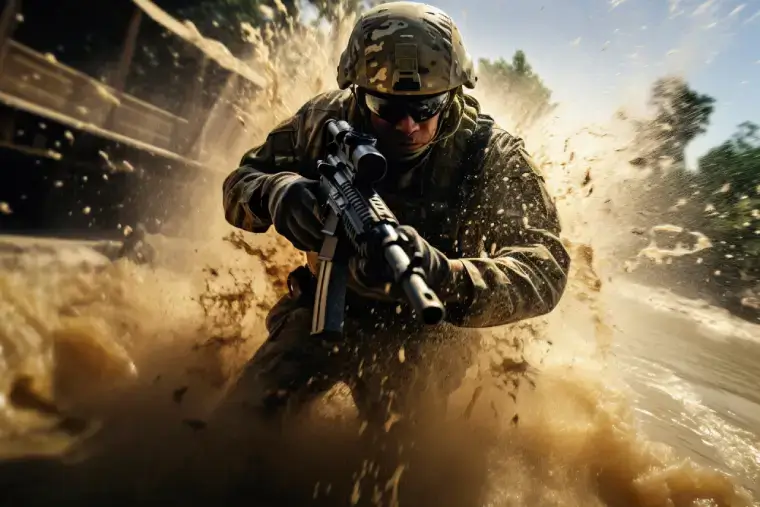

Twenty years in, Call of Duty is still the biggest name in first-person shooters. Annual releases, sales consistently in the tens of millions, a cultural footprint that extends well outside the usual gaming audience. The franchise has outlasted dedicated competitors, survived genuine controversy, and kept finding new players while holding onto the existing ones.
People who dismiss it tend to underestimate how hard that actually is to sustain.
The Guns Feel Good
The most fundamental reason people keep coming back is how the weapons feel to use. The weight of them, how recoil behaves, the audio when a shot connects, the feedback you get when you hit something. This is genuinely difficult to get right and Infinity Ward, Treyarch, and Sledgehammer have been refining it across two decades of releases. The gap between how shooting feels in Call of Duty and how it feels in most of its competition is still noticeable if you spend time with both.
This matters more than it might sound. How a weapon feels is something you experience on every single input you make while playing. Get it wrong and nothing else in the game compensates for it. Get it right and it creates a foundation that forgives a lot of other shortcomings. Call of Duty almost always gets it right, which is why people who complain about every other aspect of it often keep playing anyway.
Map Design
Call of Duty multiplayer maps are almost always built around a three-lane layout: two outer routes and a contested area in the middle. This is sometimes criticised as being formulaic, and taken in isolation that's a fair observation. But the structure exists because it works consistently across a wide range of player skill levels. People learn where fights tend to happen, rotations become something you can plan ahead, and the knowledge of how a map works actually has value that improves over time.
The maps that people remember most fondly, Rust, Terminal, Shoot House, Shipment, all execute this structure particularly well. They put you in combat quickly and keep the pace up without descending into pure chaos. That's a harder balance to strike than it looks from the outside, and it's why these maps get requested and re-released repeatedly.
The worst maps in the series are usually the ones that break this pattern without replacing it with something better, leaving players wandering around without clear lines of engagement and getting shot from angles that feel unfair rather than skillful.
Warzone
When battle royale became the dominant format in online gaming around 2018 and 2019, Call of Duty needed an answer. That answer was Warzone, launched in March 2020. The timing turned out to be fortunate given what was happening in the world that month, and the game grew to over 100 million players within its first year.
What Warzone brought to the battle royale format that wasn't already there was the buy station system: your squad accumulates in-game cash during a match and can spend it to bring back eliminated teammates. This softened the all-or-nothing stakes that had put more casual players off PUBG and early Fortnite. Dying in Warzone doesn't necessarily mean your game is over, which kept people playing longer and made the format more accessible without removing the tension.
It also tied directly into the annual release at the time, Modern Warfare 2019, sharing weapons and progression between both games. Playing one felt connected to the other, which was a smart way to extend the value of both.
The Controversy Question
Call of Duty has never been far from controversy and it's worth addressing that directly rather than dancing around it. The No Russian mission in Modern Warfare 2 generated genuine mainstream media coverage in 2009. Questions about the games' depictions of violence and their appeal to younger players have followed the series ever since.
The monetisation approach in more recent entries has drawn criticism that has more substance to it. Battle passes, operator skins, weapon blueprints, and limited-time cosmetic bundles add up to significant ongoing spending on top of the price you already paid for the game. There have been periods where the lines between purely cosmetic purchases and things that actually affect how the game plays got blurry enough to cause real frustration. The wider gaming conversation about loot boxes a few years back touched the series directly during the Black Ops 4 period.
Activision's general response has been to continue as before, and the commercial results haven't punished that approach. That doesn't mean the criticism is wrong. It just means the audience has kept buying regardless.
Campaign vs Multiplayer
Something that often gets missed in discussions about Call of Duty is how seriously the campaigns have been taken at various points in the series. The original Modern Warfare in 2007 had missions that genuinely tried to say something about the experience of modern warfare, told from multiple perspectives, and the ending hit harder than most players expected from the genre.
That tradition has been inconsistent across the series, but it's worth noting. Black Ops had a storyline with actual twists. Modern Warfare 2 and 3 were blockbuster action cinema translated to a game. Some campaigns have been weaker, particularly in recent years, but the series at its best has shown it can do more than just provide a framework for the multiplayer.
Where It Is Now
Modern Warfare III in 2023 had a mixed reception, mainly because the campaign was short and leaned on a more open sandbox structure instead of the scripted, cinematic missions people were expecting. Multiplayer was received better, bringing back remastered maps from the original Modern Warfare 2 that fans had wanted to see return for years.
Black Ops 6 in 2024 introduced a new movement system, Omnimovement, that allows players to sprint, slide, dive, and aim in any direction without restrictions on which way you're facing. It was a genuine change to how the game feels at a fundamental level, not just a visual update, and early responses were broadly positive.
Twenty years in, nobody has seriously challenged it for the top of the genre. That's the simplest and most accurate thing you can say about it.