
Rebooting a beloved franchise is a gamble. The audience already has a relationship with it, a set of expectations, and usually a strong opinion about what made it good in the first place. When Santa Monica Studio announced that the 2018 God of War would ditch the Greek mythology setting, swap out Kratos's chain blades for an axe, and centre the whole thing around a father and son relationship, people weren't quite sure what to make of it.
Within the first hour of playing it, most of those concerns went away.
The Camera
The most immediately noticeable thing about God of War 2018 isn't the setting or even the story setup. It's the camera. The original trilogy used a wide, pulled-back view that put spectacle front and centre and made combat feel cinematic and slightly removed. The 2018 version places the camera directly over Kratos's shoulder and never cuts away for the entire length of the game. No loading screens disguised as crawling through gaps. No cutscene breaks. One continuous shot from start to finish.
That was a serious technical challenge that took years to solve properly. The reason for doing it becomes clear within minutes of playing: it keeps you close to both characters at all times. When Atreus is scared or frustrated, you can read it on his face because the camera is close enough to show it. When Kratos is holding something back, you see that too. The distance that the original games maintained between player and character is completely gone. It makes everything feel more immediate and more personal.
A Different Kratos
The original God of War games built Kratos as a force of destruction. He was angry, brutal, and genuinely fun to play as, but the characterisation didn't go much deeper than that. The premise was that he wanted revenge and he was very effective at getting it. The 2018 version asks a more interesting question: what happens to someone like that after the revenge is done?
This Kratos is trying to be different. He knows what his anger has cost him and everyone around him across his entire life. He doesn't want to hand that down to his son, but he also doesn't have much of a reference point for any other way to be. He grew up in Sparta. He became a god of war. Nobody ever taught him patience or gentleness or how to have a conversation that doesn't end in someone getting hurt.
Watching him try to figure out how to be a father, in real time, with a kid who needs more from him than he knows how to give, is genuinely moving. The writing earns those moments rather than demanding that you feel something because the music told you to.
He also talks less than the old Kratos, and that restraint carries weight. When he does say something meaningful to Atreus, it lands because it doesn't happen constantly.
The Leviathan Axe
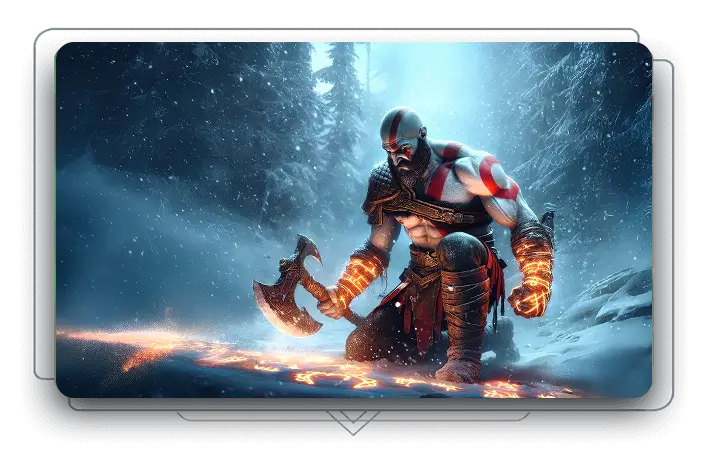
From a gameplay standpoint, the axe is what most people remember. It's heavy, it's satisfying to use, and throwing it and calling it back with a button press never stops feeling good no matter how far into the game you are. Watching it arc back through a group of enemies on its way back to your hand is one of those small moments of joy that the game keeps delivering across its entire runtime.
The axe also has properties beyond just dealing damage. It can freeze enemies, interact with environmental puzzles, and create opportunities in combat that a straightforward weapon wouldn't. Learning to use it properly, including when to throw it and leave yourself temporarily unarmed, is part of what makes the combat more interesting than it looks in early footage.
Later in the game you get the Blades of Chaos back, and having both available changes how you approach different encounters. Some enemies are more vulnerable to ice, others to fire, and working out which to use and when becomes a genuine part of playing.
Atreus
It's worth talking about Atreus separately because companion characters in action games have a long history of being liabilities: getting in the way, needing to be protected, breaking the pace of encounters. Atreus does none of those things. He contributes to combat meaningfully, calls out enemies you're not facing, and develops his own skill set as the game progresses.
More importantly, his relationship with Kratos develops in a way that feels natural rather than scripted. The early awkwardness between them is real. The moments where they start to understand each other better are earned through things that happen during gameplay, not just in cutscenes. By the end of the game you've spent enough time with both of them that what happens to either one actually matters.
Ragnarok and What's Next
The 2022 sequel finished the Norse saga across all nine realms in the mythology. It expanded on everything the 2018 game established: more characters, more environments, higher production values across the board. It didn't try to reinvent the formula again, which was probably the right call. It built confidently on what was already working.
Santa Monica have confirmed another chapter is in development. Setting and mythology are still unannounced. Whatever they land on, they've demonstrated they know how to make the format work with any material.
Why It Still Gets Recommended
God of War 2018 keeps appearing on best-games lists years after its release because it managed something that most action games don't: it made you care about the characters as much as the combat. The fighting is genuinely good. The world is visually impressive. But the reason people remember it the way they do is Kratos trying to be a father and not quite knowing how. That's what separates it from everything else in the series and most other games in the genre.